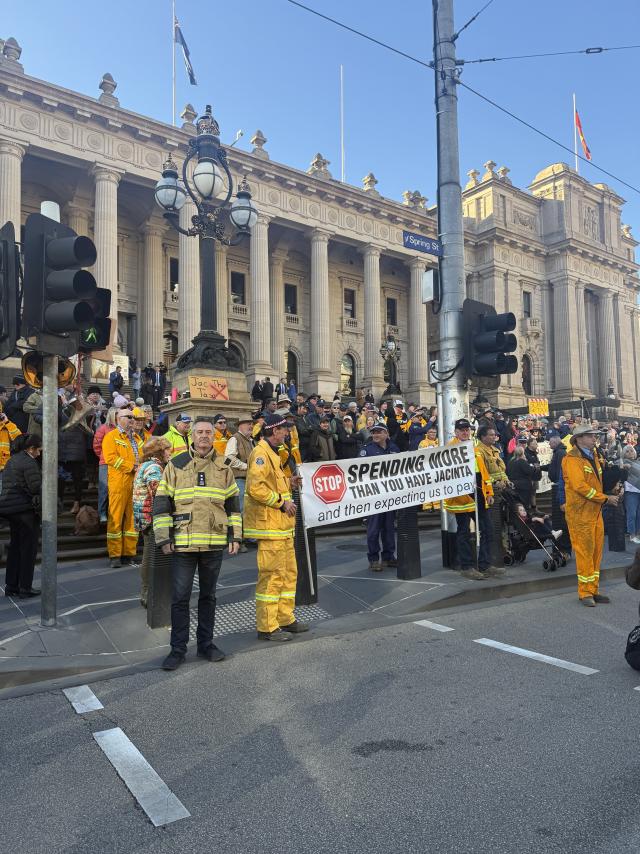
Career/professional and volunteer firefighters are warning Premier Jacinta Allan about the critical lack of firefighting capability after fire services budgets were allegedly cut despite the State Government controversial tax.
Ahead of a predicted horror fire season, Union Secretary Peter Marshall, Andrew Weidemann AM of the Across Victoria Alliance and John Houston President of CFA Volunteers Group Inc have written a joint open letter calling for urgent action as the state enters a high-risk bushfire season with a fleet that is increasingly aged, unreliable and unsafe.
The recent alarming forecast from the Australian and New Zealand Council for Fire and Emergency Services shows half of Victoria at high risk ahead of a dangerous summer.
Southeast CFA brigades have been deployed to put their lives on the line to protect their local communities, including those in North Victoria.
Meanwhile UFU reports that approximately 800 CFA fire trucks are over age and more than 64 per cent of Fire Rescue Victoria’s 200-strong fleet are past their 15-year use-by-date.
“With FRV’s, they are in direct breach of their replacement policy. Leaked FRV documents reveal “critical” truck shortages through October and November,” spokesperson said.
Reports circulated on 14 October, 21 October, 28 October and 5 November showed up to 34 trucks offline in each week – roughly one in six of FRV’s trucks out of action. “Critical” shortages are declared when there are more than 29 trucks out of action.
This issue has already played out locally. In September 2025, a Fire Rescue Victoria pumper responding to a car fire in Pakenham suffered repeated mechanical failures during the incident, with the truck’s pump malfunctioning multiple times while firefighters were actively fighting the fire. The appliance involved was a 14-year-old truck nearing the end of its service life and had experienced an earlier pump failure the same night.
UFU further understands that in relation to DEECA’s fleet being fit for purpose with an ability to respond to emergencies is significantly compromised.
“In this context, CFA volunteers are increasingly expecting modern safety protections. This represents an unreasonable and unacceptable transfer of risk onto volunteers who already contribute so significantly.”
Despite collecting an extra 610 million dollars through the Emergency Services and Volunteer Fund since its introduction, firefighters say frontline crews have seen no meaningful improvement in equipment or fleet safety.
United Firefighters Union Secretary Peter Marshall said Victoria is in the middle of a fire truck crisis with firefighters responding to emergencies every day with no certainty that their equipment will hold.
“We’re calling on the Premier to immediately commit to replacing the fleet and restoring capability,” Mr Marshall said.
“It’s about ensuring firefighters are not sent into life threatening situations with outdated and unsafe trucks. Lives depend on it.”
Andrew Weidemann AM from the Across Victoria Alliance said volunteer firefighters, many of whom are farmers, will again face the consequences of government inaction.
“When trucks fail or capacity is stripped away, it is regional communities and primary producers who feel the impact first,” Mr Weidemann said.
“Farmers in rural Victoria are already paying the levy, volunteering to fight fires, and on top of that supplying critical firefighting equipment at their own expense.”
“This additional investment places a significant financial burden on farmers, particularly as CFA’s ageing fleet increasingly struggles to manage large-scale fires without their support”
John Houston President of CFA Volunteers Group Inc said volunteer firefighter volunteers are stepping up and they are doing it without trucks and equipment they need.
“People give their time, their skills and often their own safety to protect their communities,” Mr Houston said.
“Asking them to also absorb the consequences of systemic underinvestment is not just unfair. It is dangerous.”
Cate Lancashire from Across Victoria Alliance, said the ongoing strain is taking a serious toll on mental health in regional communities.
“The mental health toll on our volunteers and career firefighters is escalating to an unacceptable level,” Ms Lancashire said.
“They’re paying higher levies and bracing for a catastrophic fire season, yet still being sent out with an ageing, unreliable and increasingly unsafe fleet.”
“Every call-out forces them to confront the same fear, not just the fire in front of them, but whether their own truck will fail beneath them, which in turn causes further stress that they won’t return home safely to family.
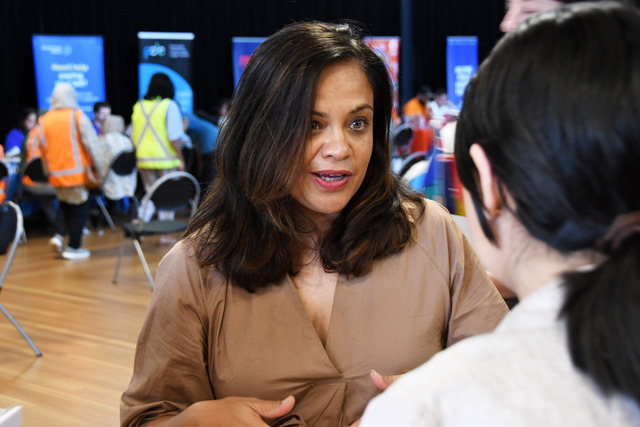
Pakenham MP Emma Vulin said “all emergency services agencies have attested to their readiness for this bushfire season”.
“As a CFA volunteer, I know how hard our local brigades work and I have absolute confidence they’re ready to keep our communities safe,” she said.
“There have been no cuts to the CFA or Fire Rescue Victoria. Every dollar raised through the Emergency Services Volunteers Fund is invested back into our emergency services – as enshrined in law.
“Through record investment in emergency services, our local brigades have the equipment they need, with new appliances delivered to Toomuc CFA, Nar Nar Goon CFA and Officer CFA in recent years.”
CFA disputes claims that funding to CFA has been cut and our volunteers and brigades are not prepared for the current fire season.
“The CFA budget has in fact increased year on year since Fire Services Reform in 2020, including an additional $20.3 million this financial year.
“In addition, on advice from the Chief Officer, the Board sought from Government additional funds to heighten readiness and community preparedness in the face of this challenging fire season.
“This request was met with an additional $11.6 million of supplementary funding for Strategic Bulk Water Supply and a statewide community engagement and awareness campaign; “Get Fire Ready”.
“To support our frontline volunteers, we continue to prioritise investment in new and replacement fire stations, fire trucks, and protective equipment, whilst continuing to advocate and work with the government to secure more investment in fleet and equipment.
“Right now, the work continues to stand by our volunteers and staff, and with those communities that are affected.”