
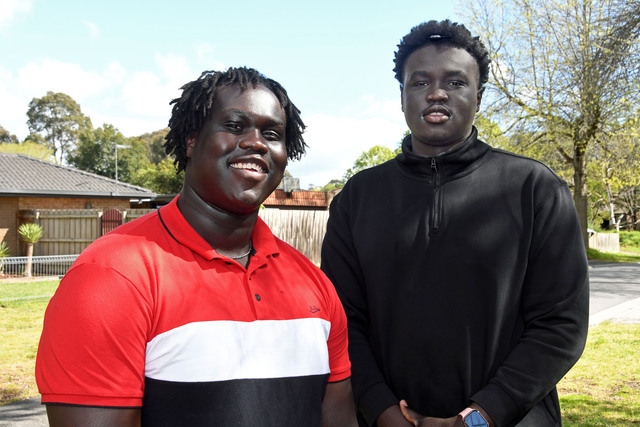
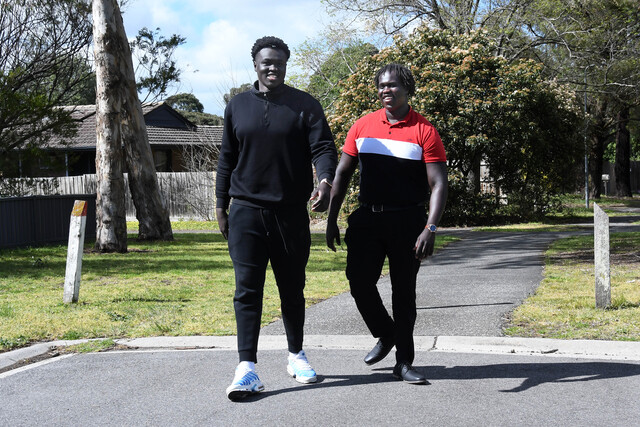

PRECEDE: Crime dominated the political agenda. Fear drove policy. Tragedy drove headlines. Amid it all, two retired gang members turned youth mentors, are proving that resilience and hope can emerge from the very streets that once defined them. Brothers Mar and Moses Riek are the Gazette’s 2025 person of the year. Journalist Afraa Kori reports.
BREAKOUT QUOTE: “So many young people are dying, so many families are grieving, but all that struggles builds resilience. We are not built to be average, we are built to excel so let’s execute.”
In a year dominated by youth crime, political upheaval, and the violent deaths of African youth, two brothers from Pakenham told a different story — one of change and responsibility.
Mar (20) and Moses Riek (24) turned their lived experience on the streets into leadership at a time when Victoria was searching for solutions — a quest that has earned them the title of the Gazette’s People of the Year for 2025.
Born in Sudan, the brothers arrived in Australia in 2005 after fleeing the civil war. Their family initially settled in Sydney before moving to Pakenham following their parents’ separation. Raised in a single-parent household, they navigated instability while trying to find their place in a new country.
Sport became their anchor. Moses stood out as an elite junior prospect selected for the NBL Combine, preparing for a tour of the United States.
Mar also nurtured dreams of playing professionally, representing his local area and building a reputation for his talent on the court.
But opportunity came at a cost their family could not afford. At just 13, Mar decided he did not want to be poor anymore — his mother, raising six children alone, could not cover the $500 plus basketball fees. For the brothers, the equation felt simple.
“If I wanted to chase my dreams, I needed money,” Mar said.
Petty theft led to selling drugs. Street connections made it easier for the brothers to form a gang with their friends and relatives. Rivalries formed along geographic and tribal lines, fuelled by social media, drill music and escalating cycles of provocation.
“We competed over status, respect, women and power,” Mar said.
Yet his involvement was brief. The same year he joined a gang, he left, realising the life did not align with who he wanted to be. He considers himself fortunate – never imprisoned or killed, which is an outcome many peers did not share.
Moses’ path ran deeper. When a hip injury ended his promising basketball career, he disengaged from school and family.
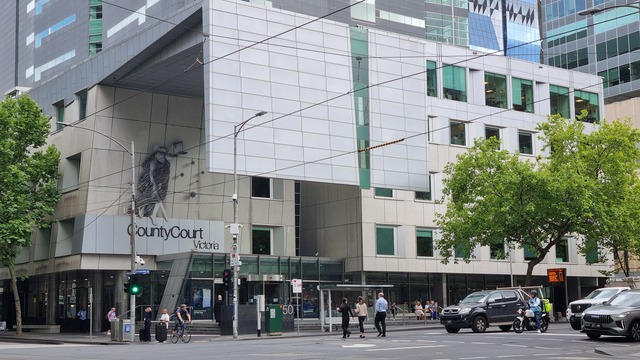
Petty crime escalated under the influence of older gang figures until, in 2020, his involvement in an aggravated home burglary in Wantirna South led to a four-and-a-half-year prison sentence.
For Moses, prison became the turning point. Through rehabilitation programs, education and reclassification to minimum security, he began rebuilding his identity. Even then, setbacks continued; a broken leg ended his hopes in boxing and basketball.
“The streets took some paths from me,” he said. “But they didn’t take my purpose.”
For Mar, that reckoning arrived through loss.
The deaths of two children, Dau Akueng (15) and Chol Acheik (12) sent shockwaves through Victoria and the South Sudanese community.
Mar knew Dau personally. He had watched him grow up, laughed with him, shared stories. Seeing his face on the news changed everything.
“It was the innocence. These kids died because of a culture we pushed, enabled and created,” he said.
“That changed my heart. If it wasn’t for him, I would have been either dead or in prison.”
Together- prison, injury and loss forced the brothers to confront the same truth: the street life offered no future — not for them, and not for the next generation watching.
Following the deaths of Dau and Chol, Premier Jacinta Allan met with South Sudanese community leaders from across Victoria, committing to collaboration on solutions to youth crime.
At the same time, the opposition called for tougher bail laws, increased police funding and adult sentences for violent youth offenders
Labor responded with sweeping reforms: banning machetes, expanding random search powers, tightening bail, and introducing “Adult Time for Violent Crime” laws that allow children aged 14 and over to face adult sentences for serious offences.
Amid the political noise and grief, the Riek brothers were quietly at work — mentoring, organising programs, and stepping in to support young people.
Today, both brothers channel their experience into community leadership.
Mar leads music programs at Next Generation Unite, teaching young people songwriting, production and engineering. Alongside Moses, they founded 1038 The Collective, an independent record label designed to empower young creatives in Pakenham and keep opportunity rooted in the community.
Moses, released from prison in 2022 and completing parole in 2023, now works with government organisations and sits on the South Sudanese Expert Working Group within the Department of Justice. He mentors young people involved in the justice system, helping them navigate support services, education and employment.
“I’m learning to be a professional,” he said. “Navigating corporate spaces, working with the government. I see my testimony as a blueprint — a pathway out of the streets.”
This year, their work reached beyond Pakenham. Mar credits early coverage by the Gazette with opening doors that once felt unreachable.
“You helped play a major part in giving our people opportunities,” he told Gazette. “You put us on. You gave us the boost. After that, ABC and SBS followed.”
“People started seeing that we’re more than just music street guys. Being able to share my story and advocate for my community on the news is amazing.
“Now, when I walk around Pakenham, I’m recognized not only for my music but also for my community work.“
With recognition came resistance. Old associates questioned motives. Rumours circulated. Respect arrived alongside resentment.
“You win in one aspect and lose in another,” Mar said. “That’s part of growth.”
The brothers are clear-eyed about crime and accountability. They do not romanticise the streets or excuse violence. But they argue Victoria’s response remains incomplete.
“We’re dealing with the branches, not the root,” Mar said.
The Riek brothers advocate a holistic, tailored approach to youth crime. They call for early intervention, inclusive youth groups, therapy, trade and alternative schooling, financial literacy, and community activities. By understanding each young person’s home life, friendships, school, and community ties, authorities and mentors can create individualised programs that guide youths away from the streets and help them reintegrate into society.
On the legacy they hope to leave for the next generation, they have a clear message:
“We are the youngest country in the world. We come from poverty, displacement, migration and survival,” Moses said.
“Then we face these struggles here too. So many young people are dying, so many families are grieving, but all those struggles build resilience. There’s no way we go through all of this just to be average. We are not built to be average, we are built to excel so let’s execute.”