Parks Victoria has released the Clyde Regional Park Draft Master Plan and is inviting community feedback.
Bounded by Ballarto Road to the north, the 120-hectare park sits next to planned new housing in Clyde South and a future City of Casey sports precinct.
The draft master plan has scaled back the developments envisioned in the 2023 Strategic Directions Plan.
Several features first canvassed two years ago have been altered or removed following “a comprehensive review process that included project background analysis, site assessments, discussions with key stakeholders, and the progression of design development”.
On the south side, a proposed lake and canoe launch are no longer included.
Park Victoria says it is to ensure the park is “operationally viable and provide a high level of safety”.
A café has been replaced with the potential for mobile food and beverage vendors to provide opportunities to support local businesses and support a flexible and sustainably activated visitor area.
Visitor areas have been relocated in response to site investigation results to ensure “appropriate protection of plants, animals, and cultural heritage values”.
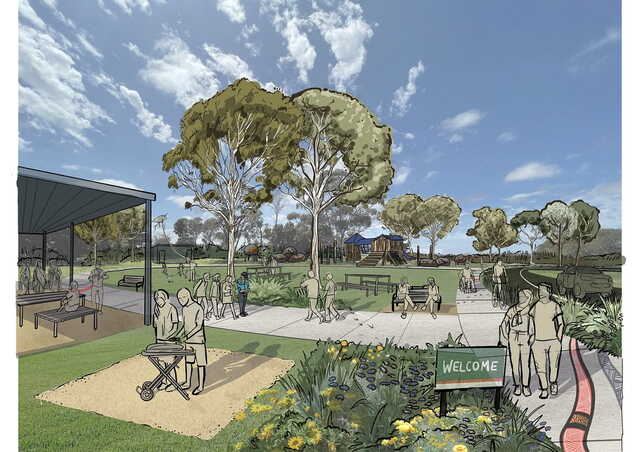
The main visitor area has been located centrally in the park, while the secondary areas have been located to the north and south. All visitor areas are accessible off Graham Road to minimise road infrastructure requirements.
Community and learning spaces elements remain, but they have been integrated into the main visitor area. Facilities include a park shelter to support community gatherings and events, along with landscaped areas designed to enable educational and hands-on learning experiences.
A formal events space has been re-cast as a flexible open lawn in the main visitor area, and walking and cycling trails are aligned to protect sensitive areas while connecting to future neighbourhood paths.
According to the draft master plan, the park has different precincts, including visitor areas, the Clyde Creek corridor, the woodlands, and the open woodlands.
The draft master plan does not propose any change for the Clyde Creek but supports and advocates for its renaturalisation (by others).
The woodlands will be central to the park’s restoration efforts, enhancing the main and secondary visitor areas through extensive replanting and habitat regeneration in the north and east of the park.
The open woodlands, located in the south, are remnants of the park’s previous agricultural use, dominated by non-native grasses.
The draft plan proposes to retain the character of this landscape while introducing clusters of native trees and shrub species, which will provide additional shade for picnicking and other activities.
As for the physical site considerations, hydrology is one of them.
Clyde Regional Park sits on land that was once part of the extensive Cardinia and Koo Wee Rup Swamp system. Over time, this landscape was drained and converted for agriculture and housing, reshaping its natural water patterns.
Today, according to the draft, the park’s very flat terrain and artificial drainage lines continue to influence how water moves across the site.
The area is naturally wet and susceptible to flooding, and future planning and park design will focus on retaining surface water in ways that both support natural ecosystems and manage stormwater effectively.
Ecology also frames the park’s long-term works program.
Surveys cited in the draft identify 72 animal species and 45 plant species, including threatened fauna such as the Southern Brown Bandicoot, Grey-headed Flying Fox and White-throated Needletail, with potential habitat for Growling Grass Frog and Dwarf Galaxias.
While the landscape has been heavily modified by agriculture and weeds, the park supports two small patches of remnant native vegetation: Swamp Scrub and Spikesedge Wetland, which provide important structures for native animals.
The draft plan states that a staged weed management strategy will be required, prioritising remnant native vegetation and linear habitat corridors currently used by native animals.
To submit your feedback on the draft master plan, visit: engage.vic.gov.au/project/clyde-regional-park/participate
The submission closes on 3 December.