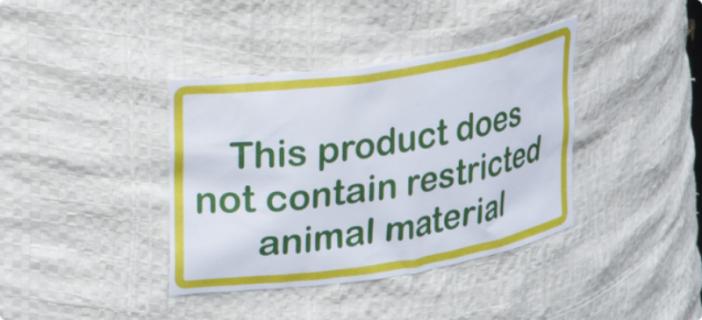
Most producers are already fully aware of the Ruminant Feed Ban, which has been in place in Australia for over 25 years.
The Ruminant Feed Ban is the banning of the feeding of Restricted Animal Material (RAM) to ruminants, e.g. sheep and cattle.
You will see reference to the Ruminant Feed Ban and the presence or absence of Restricted Animal Material on the labelling of any bag of stock feed.
The Ruminant Feed Ban was introduced to help ensure Australia’s ongoing freedom from ‘Mad Cow disease’ also known as Bovine spongiform encephalopathy (BSE). The ban ensures that even if the BSE disease agent were ever introduced to Australia it would not be able to establish a cycle of infection and result in disease.
In other words, the Ruminant Feed Ban is protecting public and animal health, and the interests of our export trade. Detections of BSE overseas have led to the imposition of trading restrictions with significant detrimental impacts on the affected farmers and the industry.
Restricted Animal Material is defined as any material taken from a vertebrate animal including meat, meat and bone meal, blood meal, fish meal, poultry meal and feather meal, manure, and compounded feeds made from these products. Tallow, gelatin, milk, and milk products are not considered to be Restricted Animal Material.
Usually, it is clear whether a livestock feed has Restricted Animal Material that must not be fed to ruminants simply by reading the feed’s labelling.
Unfortunately, there have been instances where producers have inadvertently exposed their livestock to Restricted Animal Material.
The scenarios have included exposure of livestock to piles of poultry litter, and to offal, plus feeding bakery or restaurant waste or surplus, e.g., livestock waste vegetable oil that contained meat. All these scenarios later affected the producer’s ability to trade that livestock.
The take-home message is to consider whether any new source of feed you are planning to use contains Restricted Animal Material before introducing it to your livestock.
For further advice, please contact your local Agriculture Victoria Veterinary or Animal Health Officer.
– Dr Jeff Cave is a senior veterinary officer.